
The "Nice Manager" Shadow
Founder Leadership Struggles: The roots of ineffective management and how to level up
If you’re a founder or new manager who prides yourself on being high-EQ and relationship-driven, this post is for you. Because those strengths can quietly sabotage you as a leader — and they’re often at the core of many founder leadership struggles.
I work with a lot of founders and individual contributors leveling up into leadership roles, often for the first time or at a larger scale. Many of them come to me feeling confused, frustrated, and stuck in patterns they don’t fully understand — classic founder leadership struggles that no one really prepares you for.
If this is you, you pride yourself on being collaborative, emotionally attuned, and strong at building relationships.
Eventually, you’re so successful that you either start your own company, or you get promoted into management. Now you’re trying to figure out how to grow from here.
The truth is, you have to make that uncomfortable and awkward shift from being a peer and friend to becoming a manager and leader. This is a coming-to-Jesus moment, with few roadmaps on what the path forward looks like — and it’s where many founder leadership struggles quietly begin. Here’s my take.
Ditch Black-and-White Thinking
The first question my clients ask me is, “What should my management style be? Should I be strict? Less friendly?”
After 15 years as an operator and coach, I’ve distilled my thinking here onto a spectrum.
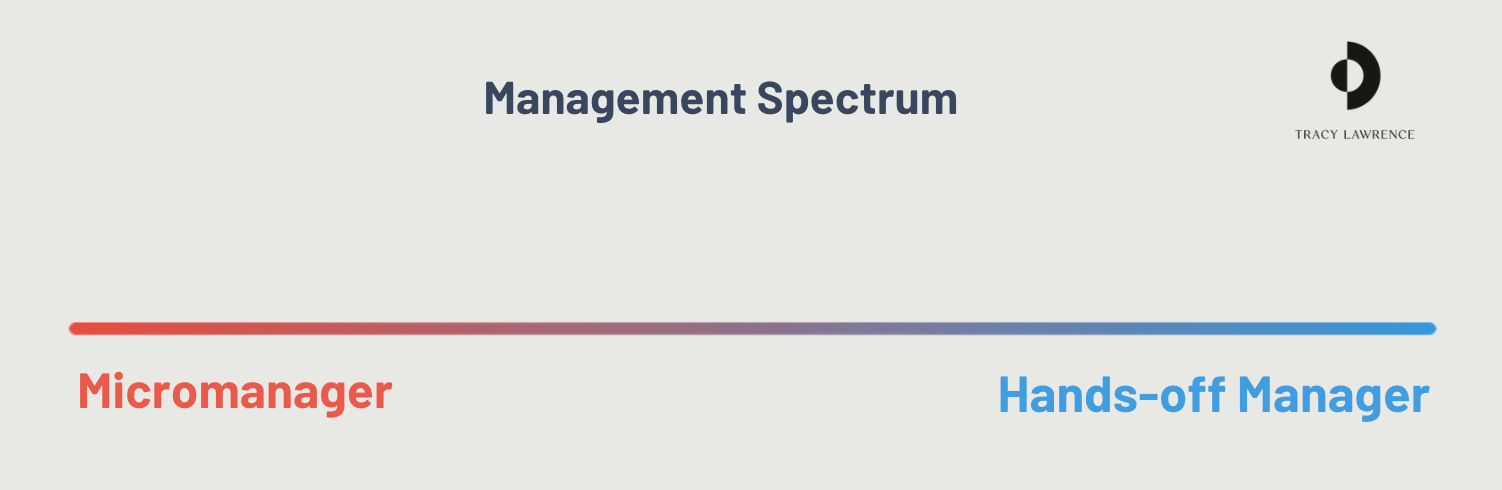
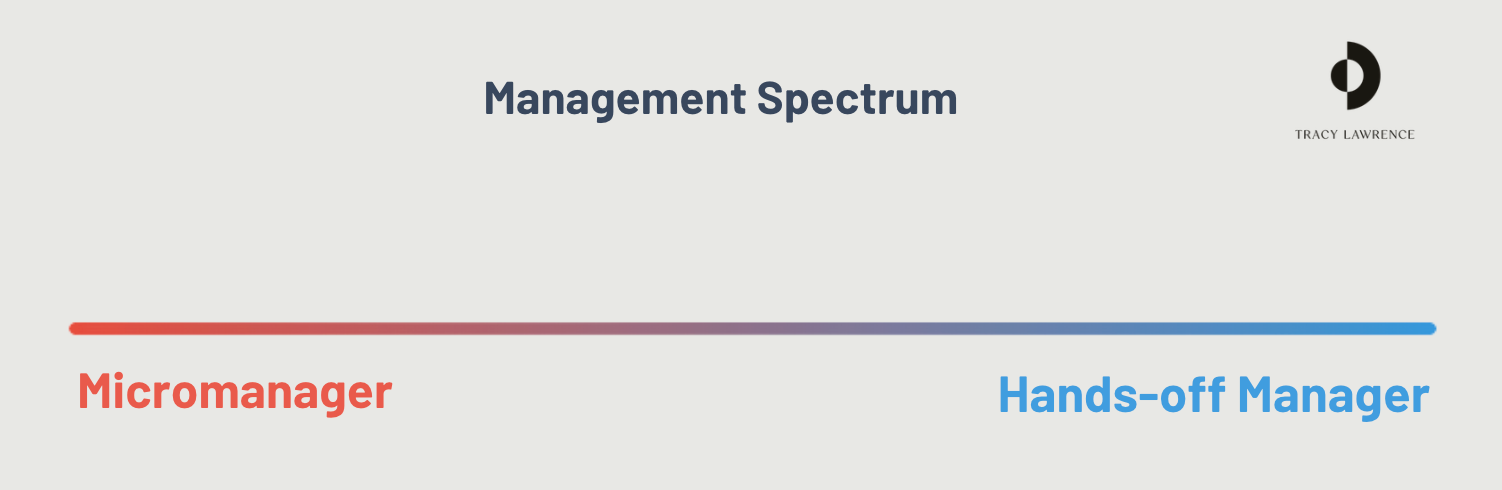
The micromanager dictates every inch of detail about what their direct reports should be doing and is constantly monitoring their workload.
If you’re a people person, you’re probably terrified of being a micromanager. Who wants to be that person? You don’t want to be all up in everyone’s grill; you want your team to know that you “trust” them.
As a reaction to that fear, you then swing to the other side of the spectrum. You lean so far back from micromanaging that you become the hands-off manager.
The hands-off manager says, “I’m going to trust you — because that’s what people want, right?” (GULP)
You’re so high-trust that you provide little to no structure, guidance, accountability, or feedback. Your team might like you, but things aren’t getting done. Your standards aren’t being met either, and that starts breeding resentment in you. That resentment often bubbles out every three months in a feedback session. But in-between feedback, you put on the “nice boss” face, which is even more confusing to a low-performing teammate.
Hands-off managers are low on accountability and feedback until it’s usually too late. They’re the ones who end up doing surprise firings (a surprise to the person being fired, not the manager). They tend to be scared of radical candor and struggle to give feedback because they don’t want to create conflict with their direct reports — a common pattern in founder leadership struggles.
Ironically, most people I work with actually need coaching to be more of a micromanager — to bring more structure and guidance to their teams. While people can intellectually understand this, there are a lot of fears and patterns that make it difficult in practice.
The Shadow of Ascendance
As a new or rising manager, you need to recognize the pillars of how you got here. The characteristics you call your strengths all have a shadow side — and for founders, this shadow often shows up as deeply personal leadership struggles.
For instance, maybe you were a strong individual-contributor engineer. You got so specialized and so good at what you do that you were promoted to management.
But the shadow side is that you don’t talk to people much. You operate in a silo and haven’t brushed up on your professional social skills. Once you’re elevated, that shadow becomes very public. Suddenly, you’re not just coding on your own — you have to take up space, be opinionated, disagree, and do it all very visibly.
Or imagine you run paid ads within a small marketing team. You’re great at cranking. You do your job with a high degree of excellence. You’re so good that you get promoted.
That excellence soon reveals its shadow: perfectionism. As a manager, you try to hold onto everything. It has to go your way because you are the best at the tasks. It’ll take too long to teach others what it would take you a short amount of time to do. You can’t let others fail...that would reflect poorly on you! So you don’t know how to share responsibilities.
You become a micromanager and your team feels smothered. They feel nervous as they watch their boss ramping up to 10 cups of coffee a day to handle her wild workload, as she approaches burnout — another familiar flavor of founder leadership struggles.
The micromanager is often born out of a fear of failure. To mask that, they employ a controlling perfectionism that makes anything less than perfect feel unacceptable.
The hands-off manager, on the other hand, is often driven by a different fear: fear of conflict. They want to be the “cool” manager (cue image of that easy-going, back-slapping, boss-friend). They believe good relationships alone will get the best work out of people.
That approach works as a peer, but it fails as a manager. It doesn’t breed excellence. It fails to bring the challenge necessary that can breed better ideas and inspire people to rise above themselves.
Deeper down, I believe the hands-off manager fears abandonment. They worry that if they bring too much conflict or “control” over a team member, that person may leave. They’d rather coddle them in an unconscious-Stockholm-Syndrome strategy of retaining talent. Creepy much? (Don’t worry, I’ve done this myself).
These managers claim that losing a key team member is expensive and will take too much time to backfill (all true). However, I suspect it touches on deeper childhood wounds of having people important to them leave. So instead, these managers put on a smile and put up with poor performance — one of the most emotionally taxing founder leadership struggles.
So where’s the balance?
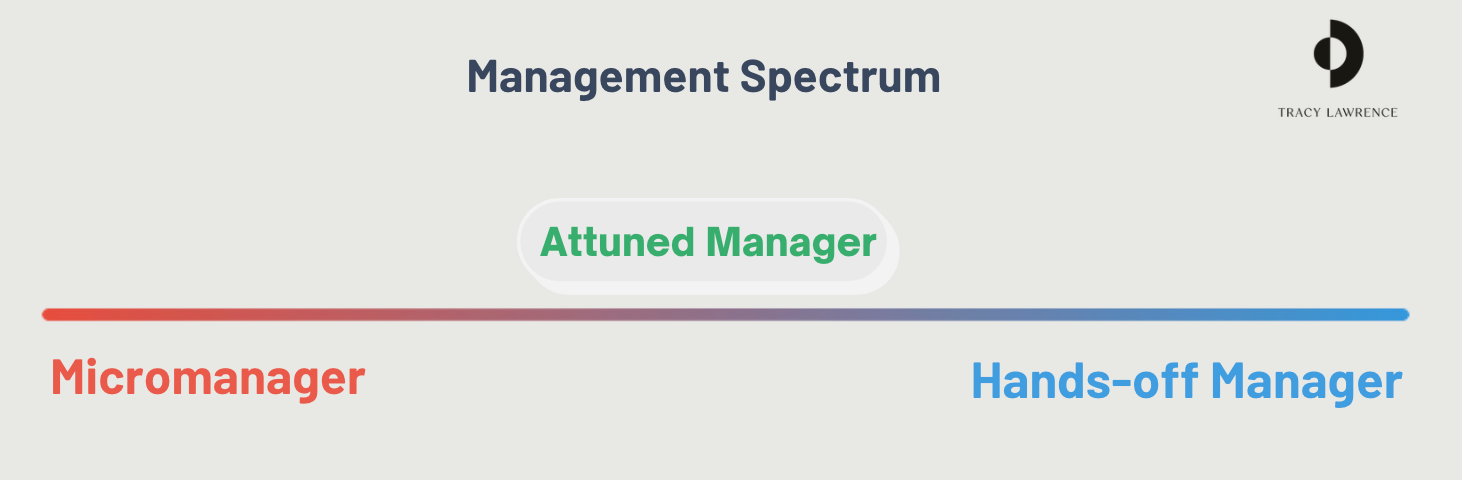
Somewhere Between the Extremes Is the Attuned Manager
This isn’t about moderation. It’s about sensing where along the spectrum you need to be in a given moment.
Great leaders move consciously along this spectrum. They don’t live at the edges.
The attuned manager has the versatility and the toolkit to move left and right intentionally. When more guidance and feedback are needed, they can step in without fear. When it’s time to loosen control, they can do that without abandoning accountability.
The attuned manager holds trust and accountability at the same time — which ultimately dissolves many founder leadership struggles at their root.
The Case for Extremes
I don’t advocate for sitting dead-center on the spectrum. Context matters. Depending on the situation, the attuned manager may need to bias toward one side — just not so far that you lose your ability to move fluidly.
First, let’s look at your team’s level of independence.
If you have a highly independent team, you can afford to be more hands-off. This is especially true for CEOs with strong leadership teams.
But if you have a junior or low-independence team, you’ll likely need to bias left. That means offering more upfront guidance and feedback to get the team performing. Ideally, you don’t stay there forever. If you do, it may be a signal that someone requires too much handholding.
The other key factor is where someone is in their employee lifecycle.
If a team member is on a performance improvement plan, you’ll likely move closer to the micromanager side. You need to offer frequent feedback to see whether they can find their rhythm quickly or whether it’s time to part ways.
If someone is a stellar, self-managed performer, you can loosen structure. But I would never counsel being fully hands-off. High performers want feedback. They want to be held to a high standard because that keeps them engaged.
And I would never advocate for full micromanagement either. That usually signals a lack of competence or fit.
Great management isn’t about picking a style.
It’s about sensing what’s needed...and not getting stuck at the edges — especially when navigating founder leadership struggles.
Lifting the Veil: Self-Analysis
If you’re a current manager, take the above spectrum and mark a tick line in one color for where you currently are with every person that you manage. Then in another color, mark a tick mark for where you think you should be for every person.
• What edges or fear come up with each person and the shift that’s required for them?
• Where do you bias overall as a manager?
• Notice the gaps. What’s it going to take to shift your thinking and your approach?
Looking at the second color of tick marks (where you should be), notice if your marks are clustered or divergent. Does your team lean towards requiring a lot of micromanagement? This is the perfect formula for burnout. You might want to consider hiring someone that requires less of a hands-on approach to free up some of your time and letting go of somebody who’s requiring too much.
Management is as much art as it is science. Allow yourself to experiment with different sides of the management spectrum. Try flexing muscles that have gone stagnant based on your personal bias.
Most importantly, do your inner work as a leader to ensure your shadow isn’t controlling you and your team. That’s how the seeds of toxic cultures are sown. It starts with you — and it’s the deepest layer of founder leadership struggles.